Sunday, 18 August 2013

Research continues


The art in a box aspect of fine art research is still ongoing and I have now managed to make a couple of reliefs as a test. See below.


Mick Welbourne who is the manager of the print room in Vernon Street, helped me to think through the process and we screened acrylic ink onto copper plate and used the ink as an acid resist, using ferric chloride to bite away the unprotected areas of copper. The best results came from about 1.5 hours biting. We also found out that ink left overnight and then screened onto the copper sticks much better and provides an even stronger resist. The shiny final look is because I wanted these cards to feel a little like the 'tranculments' or ornaments I used to polish with my mother when I was a child. The years of polishing had worn the images on the horse brasses and similar ornaments down, but at the same time they had developed a patina that clearly communicated my mother's domestic love of being house-proud. I need to keep touch with the source of my ideas and each time I refer to my childhood it seems to be a touchstone that grounds the deeper significance of my practice.

These metal reliefs will  be used to make ‘card houses’ or can be displayed on the floor or on a wall or within the fine art area's 'travelling box’ depending on the final design and or rules for display that the group devises.

I’m also planning to get the cards screen printed in colour on an appropriate card, so that full sets of playing cards can be produced and tarot type games played.
This is a colour test for one image to be printed in three colours and then guillotined to make 16 cards, there will be four of these printed and the dog biting it's tail used as the image on the reverse of all the cards. 


The practical aspects of the research are however taking much longer than anticipated and I’m not sure when I will have all these things completed because most of the Blenheim Walk workshops are being refitted and the Foundation course starts back next week, which means that the Vernon Street printroom and staff will be snowed under with inductions soon.

However, I’m balancing this work with three other projects, one of which is to develop a more theoretical strand, in which I’m looking at going back into specific aspects of drawing research (the grammar and syntax of drawing language) and linking with a member of staff from the Hong Kong Institute who is also interested in this area. I'll post a complete review on this at some other time as it is complex and detailed, but intimations as to where I'm coming from with this are already recorded in earlier posts, look at the posts tagged drawing. 

However I’m also still learning how to use 123d Catch software and have been exploring the ways it can be ‘glitched’ by giving it insufficient information to process by taking out of focus photographs or focusing on unimportant areas and editing out the areas I don’t want. As I’m also working on the forthcoming exhibition, “There is nothing like a good shave to make a pig feel like a man again”, which will open on the 15th of September, it seemed like a good idea to explore the possibilities of using new technology to go alongside what I’m doing using traditional hand drawn techniques. The image of pigs has been used as a metaphoric substitute for people, (long pig etc) by several cultures and our close relationship with animals and their representation goes back to cave paintings from 30,000 years ago. This aspect of time is something I’m going to explore further in the more theoretical research. Hopefully once the college starts back again and all the workshop areas are in full swing, I will also be able to get some actual 3D objects made using ‘123d Make’ to control the output. As you can see from the image below, the paradoxes of inner and outer, object and environment can be played with and  reconfigured in potentially very interesting ways. 


The knitting of various strands together and the weaving in and out of practice and theory also reflects the design of the new pathway structure in fine art and the introduction of the COP3 module, which is designed to get students to keep being involved with practice while developing theory alongside it. The previous use of dissertations to develop a more theoretical underpinning to practice was felt to often create a schism between practice and theory, students often neglecting their practical work while they concentrated on bookish learning. Hopefully I can get enough work done to provide an example of how the two forms of thinking can be undertaken in such a way that they enhance each other. 

Thursday, 1 August 2013

More research


I have to evidence a total of 6 days research. Something that is actually very hard to do as I spend the majority of my time making art or thinking about it in some way. This blog therefore also becomes a form of evidence as to how the pedagogical aspects of research can be manifested. 

I have continued making fires and now mountains, the two images that I took from the cards I produced of isolated images. What is of course the point here is that this could be any two/three whatever number of images from that matrix, these two were simply chosen because of some basic formal connections. Part of my research is to look at the possibilities of narrative generation using a format similar to that of Tarot reading. Therefore I am interested in that period of time before Tarot cards were fixed and what sort of images were brought into the mix and what sort didn't make it. I'm also interested in the fact that more contemporary writers such as Italo Calvino, have been able to revisit the Tarot and find it still a useful generator of narratives. I'll return to this, because the 'art in a box' area of research is also important here and I yesterday I went to a day session where as a fine art team we looked at this.


In the original sketchbooks, above, I draw approximately 100 images that were singled out from existing drawings as having potential for more ‘life’.


The fire and mountain images were both chosen for transformation into more ‘iconic’ formats. (See card matrix images in earlier post)

The more I have examined the issues surrounding the use of 123DMake which is the programme that comes with 123DCatch the more I realised that the initial model was unsustainable as a image that could be produced using the technology available. So I have continued to make more models.


The model above is made in black light control aluminium wrap. Some of the ideas associated with the absence of light were interesting but as an image it didn't really work. 


The image above is plastercine over card, is more iconic and closer to what I wanted, it also triggered my interest in plastercine as a working method, so I moved on to mountains. 


Each model is not only different in structure and image potential, but I have been using a type of  ‘Ur’ history of materials to play with further associations. (Ur-history was a term introduced by Walter Benjamin, he recognized that everyday materials carry within themselves a history of their making and of course this includes the invisible lives of the workers who made the objects) Not only do ‘cheap’ materials mean they are more assessable but they carry with them secondary levels or associations. Imported cheap beers are bought encased in cardboard and echo Nordic drinking rituals, (see image below of the first stage of building) plastercine has intimations of childhood making, cotton wool is for babies, light fast black aluminium wrap is designed to totally exclude light and is used within the photographic/film industry, etc etc.


I’m also still looking at the objects’ 3D potential for being taken back into the woodwork-shop and the flames I’ve made so far, are I’m afraid too insubstantial but the mountains are a totally different issue and my next job is to convert these into 3D images and look at their potential for physical realisation using CAD.

One technical issue has been the fact that 123DCatch wont download onto a Mac. This means that I can’t use all its properties, in particular I cant edit and save for import into 123DMake. I have spoken to Matt one of the technicians about this and he will I hope get a copy downloaded onto a more accessible machine in college. These are important issues because one of the reasons for doing this is to understand the potential frustrations for students taking on work in this area and the bugs need to be ironed out before October when their inductions into workshops start. However I can do screen grabs and manipulate these in Photoshop. In this case perhaps the idea of a fire image being also a mountain starts to become apparent. 


I'm also starting to think about printmaking again and I shall be spending a couple of weeks in the print room in August in order to explore other related issues and to make small metal reliefs that are related to the 'art in a box' research. 

Art in a box is a fine art area focus that came out of transport issues in relation to sending work off for exhibition overseas. We spent a day looking at possibilities this week and although I couldn't stay all day, I was able to contribute and I made a cardboard model of how I thought a custom made crate could have internal adjustable compartments. In this way as individuals we could put forward for exhibitions work that could fit a variety of spaces. Perhaps more on this another time. Suffice it to say that by developing a Tarot card type relationship with the images from my large drawings, (which had to be shipped in separate large heavy cardboard rolls) I should be able to develop a series of small units that can be arranged in different ways and therefore curators can determine the possible narratives. This makes a significant difference to  the existing methods of presentation. On the one hand I may have a series of related screen prints and on the other a collection of small metal reliefs to put into the box. 


These two images above are details that come from a just over 8 feet wide drawing, the individual elements (you can see a fire in space above) coming together in a fixed space to construct an allegory. 

NB These latest large drawings will be getting a first pubic exhibition showing in September. 

I mentioned at some point that I’m putting on a small show on in the library in September as part of the ‘Library Interventions’ initiative. I had a meeting with them this week and have agreed that readings will be part of this. It’s good to see the ‘Art in Fiction’ text extending its life further and I shall be undertaking an opening reading on Friday the 13th of September at 4pm in the college Blenheim walk gallery.  I will also be taking over a bookcase in the Blenheim walk library and presenting the novels in such a way that it showcases the cover images. 


See more about art in fiction here: http://www.blurb.co.uk/books/2325730-art-and-fiction

Tuesday, 16 July 2013

Research


It’s summer and that period when most people tend to think anybody working in education gets a very long holiday. This is the first year that I wont be planning for September, so timetabling, putting together new lectures, bringing in new staff, writing reports or dealing with the many and various administration issues that relate to being a manager in education have all been swept off the table because of my downsizing as part of a phased retirement.
However the college has moved into the HE sector, so research is now on the agenda as part of our timetables and I’ve developed a proposal that will have to be implemented this summer.
I don’t usually mention my own work when writing this blog as there are several other outlets for thinking about that, however this summer I have to record the fact that I am researching in order to quantify the amount of time and prove that I have not been sunning myself on some beach.
So what have I been doing and how does it link through to pedagogy?

The big change for the fine art programme is moving towards strands.(Painting/Drawing/Sculpture/Media)  I will be placed in the drawing strand and be expected to support students moving in this direction. One of the issues that we are keen to pursue is that we don’t want students to restrict their working methods to traditional drawing approaches and we would like to see then using both new and old technology as well as drawing in space using 3D materials, or thinking of film as a support for drawing, (animation). Drawing will be seen as a conceptual driver rather than as an area categorised by what sort of materials you use. I have therefore decided to try and push my own practice into other areas to become more familiar with what the college workshops offer and to rethink where the boundaries of my practice lie.

The first area I’m looking at is the introduction of CAD into the wood workshops. I have done an induction into 123D Catch which is image capture software and so the first stage this summer has been to first of all access the software myself and then get to grips with its possibilities.


I have developed my research proposal around the development of allegorical narratives, in particular I’m interested in the time when stories started to coalesce around alternative formats such as the Tarot, which allowed people to shuffle known narratives into new possibilities. Certain elements within stories had become so well known that they could be isolated from the stories and yet still be clear enough to keep pushing new narratives forward.

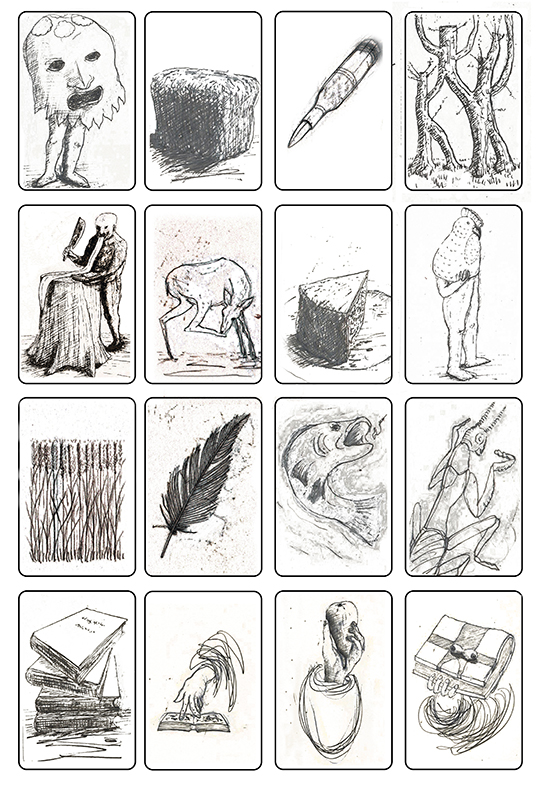
In my own case the first stage has been to isolate a series of images that I use over and over again in my own practice. These I have tried to clarify as a set of card type images. See below:


I’m using these images to research how far I can push their interaction and readability. So for instance if you look at the bottom set of cards we can take an image such as the campfire and start to explore how far this can be pushed. Stage one has been to make a 3D model. This was made out of an old pizza box and some masking tape. (The issue here is that expensive materials are not required and therefore students can see the possibility as one they can take on without cost) 


The next stage was to take between 70 and 80 photographs of it from different positions. These are then loaded into 123D Catch and manipulated to cut out unwanted background details, (the backgrounds are though very interesting and I shall probably return to these at a later date). Once loaded up I can manipulate the image by rotating on screen, panning and tracking as you would with any other 3D software package.


Immediately the meaning changes and an image of fire, something insubstantial and flickering, is now solid and mountain like. Therefore the first issue is that of how an old meaning, (the four elements of earth, air, fire and water) can be renewed. I can make the fire more mountain like to compact opposites and perhaps bring out other possible readings. (It is of course fascinating to me that the mountain, another image I use quite a lot, is only two moves away on the image/card matrix I have developed) This is where social media comes in. By posting images online you get immediate feedback and this has helped me re-contextualise what the images might develop as. Campfires and mountains were read by one person as intimations of a Nazi past, the configuration of the logs for the fire perhaps suggesting a swastika.


 This immediately grabbed my attention. I had been designing and getting printed what I called “Hell Wallpaper” as well as headscarves which came from a series of drawings I was doing about the atrocities we have inflicted upon ourselves and which we still persist in doing. These drawings included piles of bodies and were ‘guarded’ by pigs. (This is another story, but it relates to the fact that my grandmother was Jewish and her family from Poland)

Visit www.spoonflower.com/fabric/1596858 and look for 'Pighellsquare' images on the left.


I now had a link between two narratives and this is important to me because I like to develop over-lapping story lines in my work, in particular the very large narrative drawings that I use to bring strands together. 


This latest planning process now including a ‘fire/mountain’ as part of a landscape for action, which will allow me to get on with the third part of a complex narrative that is being sustained over three drawings, two of which have already been completed, each of which is approximately 8 feet wide. 


I’m also booked into the print workshop because I want to investigate both the potential for standalone silkscreen prints and to explore the potential for making low relief metal images that can be organized is many different ways, in a similar way to a pack of cards, but also with the potential to be built like a house of cards, once again trying to push the metaphors around.

The strands I’m working with move between the development of technical competence and conceptual awareness which is what we are aiming to develop with the students. The USP of our programme being that we believe that artists ‘make’ things and that by developing technical competences ideas have much more of a chance of taking flight.