Showing posts with label year 1. Show all posts

Saturday, 16 November 2013

Fine Art Year 1 Week 7

I mentioned last week that I would be doing more workshop based contextual studies sessions and these have started. Monday's session was about unpicking a given text. I set out 4 tables, each one with 5 chairs and on each table placed  5 copies of one of the texts that students can chose to give a PowerPoint presentation on. Each group of 5 had to decide who was going to read the text and annotate it, one student had to conduct a very close reading and underline and annotate one particular section of text, another had to skim read and try to sum up the text by skipping through it and highlighting what seemed to stand out. Three were sent off to the library to make initial searches about the text, one to research the time period and general history (all the texts were from the 1950s or 60s), one to research art of the time and one to research responses to the text. The three library researchers had to return within an hour to report back to the two readers. The whole group then had to form some sort of conclusion as to what each text meant. This was to force them to get to know at least one text and it demonstrated 5 different activities that could go towards the development of their individual PowerPoint presentations. At the end of the session, I asked them to compile all the information and working collaboratively put a presentation together for me next week. This will give each group a chance to practice their delivery skills and should highlight flaws in presentations, flaws which can be avoided when they present the PowerPoints for real.
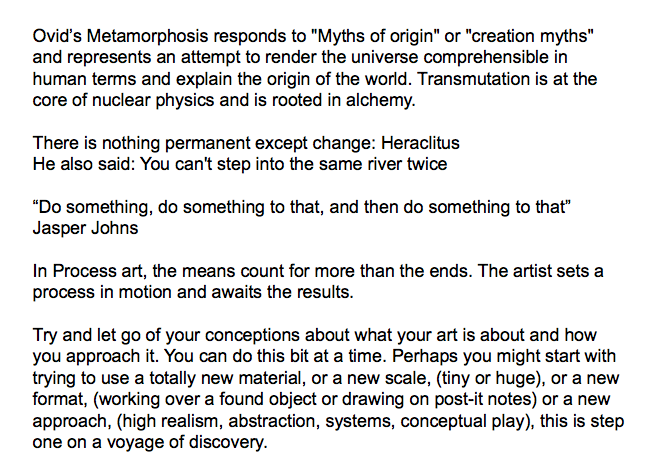
All the students were given a basic PowerPoint structure to work to. This is it.


The texts were taken from:Harold Rosenberg: Action PaintersClement Greenberg: Modernist PaintersLucy Lippard: The Dematerialization of the Art ObjectSusan Sontag: Against Interpretation


Tuesday was again catching up with students that hadn't been seen and I was working my way round both studios seeing students one to one and asking similar questions to last week. There is some very interesting work being done and students seem fired up by the idea of entering strands, hopefully they wont be disappointed when they are allowed to specialise. Some are clearly painters/sculptors etc but quite a few have too little previous experience to decide and therefore can tend to opt for painting as it is the one area they have already experienced. We shall see.

Wednesday, 6 November 2013

Fine Art Year 1 week 6


I delivered the final part of the first phase of the contextual studies element of the individual and social brief on Monday. This was focused on ideas surrounding identity and how as individuals we ‘realise’ ourselves. The students seemed more responsive to this than the social aspects introduced last week, perhaps in our society they are tuned in far more to the self. Each week I also recommend students watch a particular old TV programme on art. There is a huge amount of material now on YouTube, the suggested viewing this week was “Shock of the New” episode 5. This will be the last of the formal lectures, most of the following sessions will be much more ‘workshop’ orientated. Students have to annotate selected texts and break them down into understandable chunks and this means that they have to be guided through close reading. At the end of the lecture I introduced these texts and pointed out that they are now all available to be downloaded from EStudio. Next week I will be giving students extracts in photocopy form and we will be working on these. I know these future sessions will be hard work, not just for me but for the students. The feedback already is that some students don’t understand why they need to understand what lies behind practice, one student in particular stating that they just want to make art not spend time thinking about it. Part of me does sympathise with this but as I pointed out at the time, if students want a university degree, they also have to prove that they can undertake academic learning. We also had a discussion about the move from artists as craftspeople to artists as intellectuals, which was hopefully much more useful.  

Some slides taken from the PowerPoint.


The area I thought was going to be the hardest, introducing Lacan and 'Mirror Theory' seemed to go OK and I thought that on the whole students could see the relevance to their own developing practice. However as I pointed out, what is really interesting is that I can't see into their heads and they cant see into mine. 

Tuesday I was back in the studios hosting critiques. I had groups of 6 and we spent the time trying to focus on what individuals should be doing, as opposed to what they were doing. By ‘should’ I mean not what the briefs suggests, but what as individuals they ‘feel’ is right. We are already half way through the first term and students will have to opt for a particular strand after Christmas. By trying to identify the ‘feeling tone’ or natural interest that lies behind the work, we can hopefully help individuals gain ownership of their own practice. This is a slow process and works a bit like this.

In groups of 6 after a short individual student presentation and a reflection back to see if we all understand what was presented, certain questions are asked. Such as, “This particular piece of work suggests that you take it forward in this way….., however this one over here suggests……. and this suggests……. Which direction feels better for you?  These suggested directions are carefully thought through and include not just differences in approach but differences in uses of materials, scale and ways of using content. Slowly students open out and we get to an area that they reflect back to the group that they are fairly comfortable with. For instance it might be that the student identifies something as straightforward as “I just want to paint”. Well if this is the case, we can focus on some simple basics, such as what happens if you mix and apply different grounds? How and why are you applying the paint in the way you are etc. Sometimes this can be a real relief to a student who is struggling to intellectualise a practice and yet deep down what they really love is moving paint around. Others will identify the fact that it is an approach that they feel comfortable with. One student for instance was coming to terms with the fact that what they wanted to do was “Make art like life”. We then spent some time trying to unpick this, what did he mean? The closest we got to was the “Moment of Epiphany” concept. He wanted to develop a way of sharpening his awareness to the everyday potential of experience. It was thought that he probably therefore needed the right toolkit for this, a still camera, sound recording equipment, video etc. and in what formats? Is this kit one of those new phones that does everything, or do you really need specialist equipment that allows you to ‘capture’ these moments at the best possible resolution? At the end of each ‘crit’ students were asked if the session had helped them become much clearer as to direction, most felt that they were now much more focused and they were asked to come up with a series of clear actions to get them moving on whatever track was identified. (I.e. make notes before they forgot what it was that had been identified)
There are problems to this approach, the main one being that students can move away from what the briefs are suggesting. However, my experience is that all they have to do is present the work at assessment in such a way that outcomes are identified, and there is always a way to do this. The real danger is that students start to feel that the course is offering nothing for them. If they seem to be simply going through a series of hoops, hoops that if documented will enable them to achieve the outcomes, at some point they will become emotionally detached from the work and either stop coming in or just lose interest all-together. The moment a student says, “I really feel excited by doing this” or “Yes that really feels like me”, you know there is a chance of something interesting going to happen. I’m a firm believer that students need to become obsessed with what they are doing, that they need to have total ownership over their work, if not we will lose them, emotionally if not physically. 

Saturday, 2 November 2013

Fine Art Year 1 week 5


I was back teaching contextual studies again on Monday, we were looking at aspects of ‘the social’.  I introduced a range of ways to think about this. Historical, (Courbet), the rise of the city as a key element within modernism, social realism, social sculpture/community art. I started with an introduction to Hegel and Marx and finished with a series of questions as to how students could develop an 'ethics for practice'. I'm also putting far more resources up on EStudio, especially links to YouTube videos, which I think are far more accessible to students who are less academic. 

Some slides taken from the presentation.


On Tuesday I was on my own again with the rest of the first year while Tom was doing his contextual studies sessions. I was working through the studios doing one to ones with students who hadn’t been seen so far that week. Students are now trying to balance three briefs, (The individual and the social, material processes and collaboration) and the hard thing for them is to understand how they can do this. Most of my time is spent trying to unblock creativity dams, which seem to be mainly the result of how we now seem to develop pedagogical structures.
Students worry about the briefs and what they mean, rather than just getting on with making. I go round trying to get them to re-focus on what they are trying to do. Most of them have much more interesting things to say about the world than the briefs imply, so I have to get them to reframe what they are doing and convince them that all they have to do at the end of the module is present the work in such a way that it demonstrates that outcomes are achieved. This is such nonsense.
I have been reading quite a lot recently and in particular some heavy criticisms of behaviourism, Skinner’s work especially. It would appear that most contemporary writers involved with cognitive thinking have realised that when Skinner and others did not include feeling or emotive understanding in their patterns for measuring achievement, it resulted in huge flaws. This has skewed our recognition of meaning. Meaning is not about understanding at all and understanding, in terms of logical process, is actually quite a small part of the reasons for how and why as humans we function. Skinner took no interest in body schemas and how concepts are grounded in the body, (Johnson’s book on the Body is excellent in terms of unpicking this) perpetuating the mind/body divide. No wonder that art students find learning outcomes difficult to grasp, it is because they are fundamentally flawed. Students want to find meaning in what they do, and so do artists. As soon as you are working with an individual and you can get to concentrate on what means something to them, you can feel the interest growing. Feeling tone is far more important than lists of what to do. It is as if the whole system is set up to punish creativity.
The one good thing has been that the open studio has been divided up by some 8 x 4 boards. This gives a variety of spaces some small and some large, allowing those who need a bit of privacy and wall space to get on with work relatively in peace.

The students I spoke to had some really interesting takes on society and the individual, (the importance of dress, the need for Gothic horror, a need to go back and reinvestigate the moment of Cubism) they just need time to find their various directions and space within which to try out various approaches to what they want to do. However sometimes we try and push them too quickly, it takes a while to get into what work is about, sometimes it’s about how its actually made (processes and materials), but at others its about what you want to say and how to say it. The briefs become arbitrary measures and set up artificial responses, so what they actually measure is how well someone answers the brief. Art education is about finding ways to materialise meaning not to develop ways of understanding, that is a job for academics. 

Wednesday, 18 September 2013

Trying to put together lectures


Putting together slides for lectures is always a challenge. In the old days of slide projectors you never had text, everything was spoken and students made notes. Because I’m ‘old school ‘ as the jargon goes, I still try and keep text to a minimum, but the arrival of EStudio is forcing a rethink.  I’ve never really been a fan of PowerPoint, but it is given to us as standard with the Microsoft Office suite. In some ways the fact that you have some control over backgrounds, fonts etc makes it worse. Not enough to ‘design’ but too much to ignore. I always start with puzzling over how much the technology is shaping the content. That said, in the end I have to get on with it, as I am expected to have a slide show supported contextual studies lecture every week, as well as presentations designed to help introduce practical modules.
The introduction of EStudio (which is a replacement of what was Moodle) has been undertaken as a standardisation exercise right across the college. In reality it doesn’t seem to look or operate anyway differently to the previous Moodle system that I was using when teaching on the Digital Film Games and Animation course two years ago.
What it means is that all course content can be loaded up to an intranet and accessed by students on line. This has been standard practice for years in most institutions, but has previously been done on an ad hoc basis at the art college.
The problem for me is that most of the EStudio content is so boring. Briefs and timetables, module descriptors and codes of practice etc. If I was a student I would want lots of ‘how to’ videos, filmed in the same environment that I was working in, so that I could see where materials were stored, watch best practice in mold making for sculpture, check on settings for welding, how to make good canvas stretchers etc etc.,  as it is I couldn’t see anything that I would have considered useful when I was a student. Paperwork didn’t interest me then and from what I can see, current students are not interested in paperwork either, except for when it comes bearing a mark. Then they are suddenly really interested in why so and so has 2 marks more or less than them.
However my lectures will go up once they are prepared. This means that they go up without me. I’m not able to do my rambling preambles around the point. Not able to make noises, clap, jump up and down and do all that stuff you do to make sure people don’t fall asleep. Above all the fact that some points are very subtle and that I have to feel my way round them, engaging the audience in a story that perhaps has no single ending, means that the PowerPoint will in some ways feel like a disused theatre set. You can wander around it but will have no real understanding of the play that was acted in front of it.
My first lecture this year will be used to kick off the first year practical programme.

Slide one:


With each slide in PowerPoint comes a notes area, something I haven’t really used before, but as students will access this on line, it seems a good idea to put an explanation in. I will put these in red, it will be easier to sort out from my rambling text:

Note: You will initially be focused on drawing – but you will also have workshop inductions as part of this initial module. So how to start? Here are some thoughts to help you – drawing is fundamental to many art practices, but you will also have to think about how you can use the various facilities and materials available to you.
Why do we start like this?
All of you will come to this Fine Art programme with existing ways of working and ideas as to how you might want to develop your practice. So on the one hand we would like to acknowledge this and give you a chance to present to others what you have been doing, however on the other hand your experience of different working processes will be very different and you may not have had a chance to explore other ways of working, or to think about how different materials and workshops might change or open out new and more challenging areas of practice.

This relates to what the students will be doing on day one. They have all been asked to do something for a ‘holiday’ project and to bring this in. This piece of work will be used as partly an ‘ice breaker’ as it allows students to introduce themselves and their existing practice to each other, and it will also be something that can be transformed into other things using the various approaches and processes introduced during these first few weeks. (I’m personally never sure about holiday projects, I would rather just ask people to bring in a piece of art they had made that they believed in)  Not that this matters too much, as students will need to let go of their existing ideas about these artworks they bring in, because the processes introduced will transform whatever the starting point is into something completely different. (Well hopefully they will, but I have run this project before and a few people have been known to stubbornly keep their initial concept going right to the end).

Slide two


I have decided to use a chair as a substitute for whatever it is the students will bring in. It makes the point that anything can be transformed and more importantly that everything can have meaning. There are no notes as the slide is all text.

Slide three


Note: Scale will be an important issue. Try and push this to extremes when exploring the potential of your initial starting point.

This doesn’t really tell the story I will verbally tell, but it will have to do. I like to get students to look underneath their chairs, get down on the floor and do stuff that means that they get their head into where they might find new or unusual viewpoints from which to see the everyday. Scale change is just one issue.

Slide four


This slide of Lucas Samaras chairs is the key slide. Students should be able to get the idea that they will be doing lots of drawings of something and using these to inform what they might make. They should also be timetabled to do several inductions into workshops while this project is going on. Their images will then be further processed in a classic 2D to 3D dialogue. Medium specificity will also be an important issue for them to think through.

Note: An initial exploration of possibilities using drawing, then taking the idea through different materials.

Again this note is very sparse. I would elaborate considerably in the talk, however part of me feels that without the banter of students asking questions I cant really explain beyond this in the note section.

Slide five:


This slide brings up the fact that students will be expected to play.  I particularly like Wurm’s ‘One minute’ sculptures, they open out the performative possibilities and are very cheap.

Note: The importance of play. Pure un-directional play can be very rewarding. But there is often a logic to this, even if it looks as if the logic is slightly odd or 'not as we know it Jim'. Take one aspect at a time and push the implications. What happens if I extend this aspect, or repeat this, or bring these things together, or make it out of unexpected materials etc.
Canhavato’s chair is made from decommissioned weapons collected since the end of their civil war in 1992. The throne is a product of the Transforming Arms into Tools project - whereby weapons previously used by combatants on both sides are voluntarily exchanged for agricultural, domestic and construction tools. Think about how the materials you make these transformations in bring with them new sets of meanings associated with their own provenance. 

I’m not going to put the entire PowerPoint up, I’m just trying to give an idea of what is being done, however these are the last two slides.

Slide 16


Slide 17


Once the talk is over students will work all week drawing and being taken out group at a time to begin workshop inductions. There will be three to four staff working across 80 students for most of this time. I shall just be there for the initial two sessions. The following week I will be giving a introductory contextual studies talk, 'What is art?'